

What Getting Published in the New York Times Actually Looks Like
Four months, five drafts, and the essay I almost gave up on. The state of publishing.

I hit send on a pitch to the New York Times Well section at 10am on a Sunday morning back in March. There was still snow on the ground.
Today, on my back porch, in the hot July sun, I finally got to see it in print.
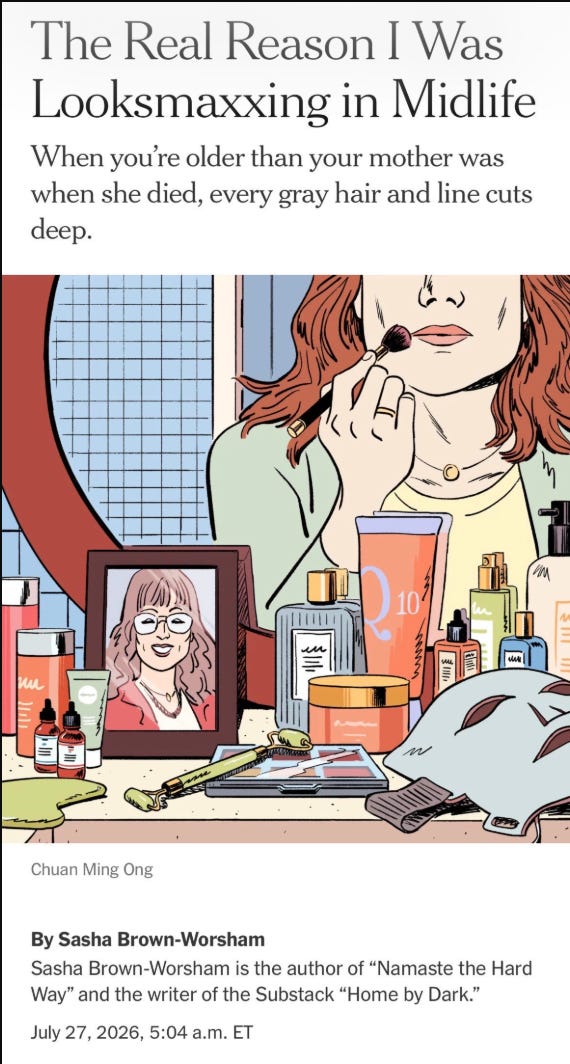
Four months is a long time to wait, though it’s not unusual in today’s editorial climate.
I’ve been a writer since before I can remember. I started keeping a journal almost as soon as I could hold a pen and from there, I was hooked. I went to undergrad for creative writing and have a master’s in journalism and writing. I’ve written for the Times before. My book deal came from this Times article. This was one they actually commissioned.
But I stopped pitching publications in 2018 as soon as my first book came out.
That’s another story. But in early March, the same week I started this Substack, I decided to start pitching again.
By 10am Monday I had a response asking for the full essay “on spec.” What this means is, I was asked to write the whole thing without any guarantee. Without a contract. It’s a common request and one that, typically, works out. If you can’t place it in the publication you pitched, you can often place it elsewhere. In my case, I would have published it here.
I asked for a week to draft it, but I drafted in one day.
Here’s a secret: In my experience, the best essays always pour out of you quickly. That doesn’t mean they don’t need editing. But the essays I’ve written that have sold the fastest are always the ones I couldn’t wait to get on the page.
I’m no stranger to the process.
A decade ago, I wrote regularly for major publications. Then I stopped. Partly because my stomach for the comments section changed after my book. Partly because we moved overseas and helping my kids adjust was a full time job. Partly because I was offered a full-time as an editor when we returned stateside and I lost my taste for writing anything non-fiction.
Then, one day in March, it returned. I started Home by Dark. I started pitching again.
The landscape had changed.
The idea
The essay is looksmaxxing, though the lens of a woman grieving for her mother who died young. Me.
But it’s about more than that, too. It’s about aging and beauty and the pressure women put on themselves. It’s about the relationship I have with my children, two of whom are already older than I was when I stopped having my mother to guide me.
I highly recommend having teenagers. They CALL YOU ON YOUR SHIT and one night in late February, I was chatting with my 17-year-old son about all things Clavicular and looksmaxxing and a story seed was born.
In case you don’t know, Clavicular is an influencer sometimes known by his real name Braden Peters. He’s the face of a movement that has teenage boys and men in their 20s doing increasingly disturbing acts to look better and thus, get more girls. My son told me this is actually a real thing. He knows real people who do this.
Just one of those horrible things your teenagers spring on you on a random Thursday night.
In the midst of my very motherly diatribe, during which I told him that looks don’t matter, that God made him beautiful — with a little help from me, he turned to me and said: “No matter what I do, I could never looksmaxx as hard as you.”
Busted. A story was born.
The pitch
Nothing is so simple, I told my kid. But when middle aged women do it, we don’t call it looksmaxxing.
Why?
My mother died when I was 16. She was 45. I am now 49. I had a birthday between acceptance and publication, which tells you a little something about the length of the process.
I have been doing things to my face for years. Lasers. Morpheus 8. A face sling that terrifies my children. I told myself it was vanity. It took me a long time to understand it was something else.
The pitch wrote itself. I sent it on a Sunday because I couldn’t wait until Monday.
My husband asked me recently how I know when a piece has legs. How I know before I send it whether it will land. It’s hard to explain, but I tried. When I’m writing something that resonates, it feels like a hot ball in my chest. It sits there, forcing my fingers to type, the words pouring out until they’re done. You can write on deadline without that feeling. But once you’ve felt it you know the difference immediately.
The pitch felt like fire. The response came the next morning.
The wait
I sent the full essay on March 11th on spec. That means sending the full manuscript without a contract, which is different from a reported piece that gets contracted before you write it. I sent it and waited.
Four weeks passed.
I sent a follow up. Professional. One line.
I was anxious. There were days I was convinced they hated it. Days I was sure they’d ghosted me. Days I almost published it on Substack instead.
I was wrong.
Four weeks later she emailed.
They wanted the essay. But there was a problem. The top editors didn’t buy my ending. It made sense. I made it too simple. Grief plus aging equals an explanation for my desire to inject my face.
But it wasn’t so simple. They were right. The pressure is on all women. Not just those of us who lost our mothers young. The answer isn’t simple. The questions are complicated and fraught.
Could I write to that?
We spent nearly an hour talking it through.
I wasn’t sure what was going to happen with it.
I considered pulling it. Twice. I was worried the news hook would grow stale. I thought about publishing it here or submitting it somewhere else.
I didn’t.
What the editing actually did
Writing for Substack when you run your own publication is very different from writing for the Times.
The most obvious difference: there’s no editor. Which is both a blessing and a curse.
As someone who edits professionally, I believe in the dynamic between a writer and an editor. A good editor sharpens the piece, points out the clichés, helps you figure out which darlings to kill.
I had a line I loved: “I have no map for my aging process.” If you’d read this on Substack, that line would have stayed. My Times editor pointed out it was a little tired. Not original enough. The punch lands harder when it stays simple.
One note changed the essay completely. I believed when I wrote the draft that my anti-aging obsession was about losing my mother. My editor wasn’t convinced.
“Women who haven’t lost their mothers are doing this too,” she said.
She was right and the essay became better the moment I stopped trying to explain everything with grief and admitted the answer was more complicated.
It was both. And it struck me that isn’t that how all essays are? The best ones don’t tell you “do this” or the “answer is black and white.” They write into the confusion. They don’t offer easy answers. They push the envelope and tell the truth and leave the ending gray.
I didn’t write the real ending until the fourth round of edits. The process helped me see it.
That’s what a good editor does. And that’s what makes working with a good publication worth the wait, even when the wait is long.
I’ve sat on both sides of this desk. I promise you that no matter how skilled you become as an editor, editing your own work is impossible. Publishing this essay was a refresher course in that lesson.
The headline
As a long-time essayist and journalist, I’m always surprised to learn that some people don’t know this: Headlines are rarely written by the writer.
In fact, most of the headlines you see in a newspaper or any publication were crafted for maximum clickability by the section editor or the managing editor, depending on the hierarchy. When I’m wearing my editor hat, I am fine with this. But as a writer, it can be less than ideal.
One of the reasons I love Substack is crafting my own H1s. Even when they bomb, I know they are mine. I’m especially sensitive to this because I don’t love the title of my book.
To be fair, I was fully in on picking it. But I didn’t push back enough. I was given four choices and I chose the one I hated least. I remain glad the book isn’t called Yoga Brat. Still, the title/headline are vital. They are what sets the entire tone for the reading experience.
When the editor reached out at the end of last week with a headline I wasn’t crazy about, I was grateful to be invited to weigh in. Like I said, that’s rare. I made a few edits that made it feel fairer to the work.
I’m happy with the compromise.
What I want it to do
I hope this essay reaches the people it needs to reach.
So much of the aging conversation right now seems designed to judge and to shame. To draw a hard line between the women who fight it and the women who don’t. But I don’t think it’s that simple. People have all kinds of reasons for the choices they make about their faces and their bodies. Not all of them are frivolous or bougie or vain.
I hope this opens that conversation a little wider. I hope it lets women see each other in a slightly softer light.
But mostly I wrote this for the motherless women. Those of us navigating aging without a guide, who run our grief math equations in the quiet, who calculate our lives against the people we’ve lost. I want women who have never had language for that feeling to read it and feel seen.
After the essay was accepted, my editor wrote something that has stayed with me.
She said she hoped it would give people language for something they’d been feeling.
That’s the highest compliment I can imagine. The byline is great. But that’s what I really wanted. To give language to a feeling that many are having and can’t name. To help to name it.
Reception
Comments can be so cruel. When I was a bitty baby writer I learned not to read them, but that was only after being stalked by my own cousin, regularly told I should kill myself because I didn’t like a certain movie, and beaten up mercilessly, every day by strangers.
The writing and reading community can be vicious. I could write a whole essay on why I think that is (scant resources, rampant envy, low pay…) but I won’t. Suffice it to say, putting anything vulnerable out there is scary. People judge themselves against you and if they feel they come up short in some way, they make it personal.
The Four Agreements. If you haven’t read it, consider it. Nothing is ever personal. It’s always about them.
Focusing on the positive, I did have a number of kind people reach out. People who saw what I am trying to do. The nuance I am trying to explore. The lack of easy answers. I made connections with fellow writers I haven’t spoken to and had many kind comments as well.
I write for connection. I must tune out the people who don’t get the “both/and” aspects I try to explore in all my work.
Compare and contrast two of the comments I’m leaving anonymous:
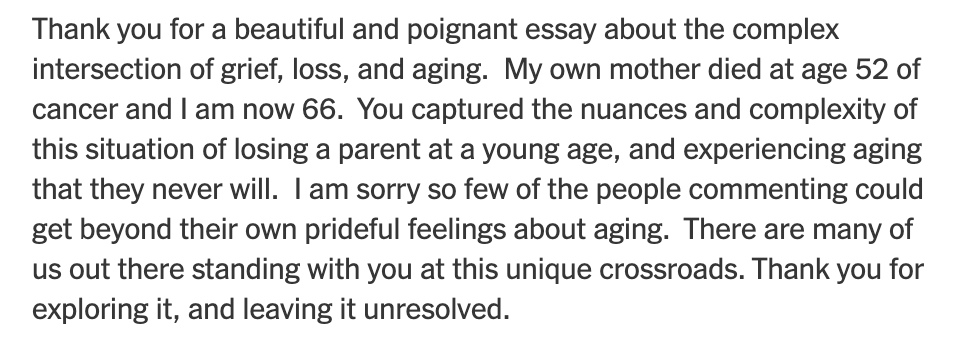
Vs.

I hate myself for saying this, but it’s true. If you aren’t ready to be beaten up in the comments section, you can’t write personal things.
On the other hand: If you don’t risk wading through the people who don’t get you and are threatened personally by what you say, then you kind find the ones with whom you’ll connect.
Be brave, fellow writers. And know I always have your back. I admire anyone willing to put themselves out there. Even when I don’t agree with what they say.
Full stop.
What it felt like
Coming back to writing essays again has felt like coming home. I know that sounds like a cliche, but I’m not sure I can come up with a better way of describing it. Writing has always been the way I work things out, the way I connect, the way I make sense of a world that increasingly makes little sense.
Moments, like the one with my son, hit differently when I put pen to paper (or fingers to keyboard). Substack has been a revelation. I never expected to end up hitting 100, let alone 2,100. I appreciate every single person who comments here, restacks, reaches out, challenges me, asks me questions, and shows up week after week.
But there is also something about remembering what it’s like to see your name in print in a major publication. It’s validating. It shakes me out of the imposter syndrome that I’d really prefer not to have 20 years into my career, but which I struggle to shake anyway.
In short: It felt amazing. Four months, five edits, four editors, much stress. Worth it. Will do again.
***
If you want more of this — the writing, the behind the scenes, the essays that don’t make it into the Times — you’re already in the right place.
There’s a new one every Sunday.
A few from the archives:
I Was the Villain In Someone Elses’s Memoir
Burning It Down Isn’t the Only Way
The First Time You Feel It, Believe Yourself
If you want to support my work, my first book, Namaste the Hard Way, is available.
The summer of 2026 is also the summer of Adult Book It. Stickers. Prizes. Six books. No pizza, sorry.
More soon.
Sasha
Once again, I wish we could have an impromptu coffee meetup and discuss all of this! When I edited and wrote for magazines (or at least for the first 15 years or so), there was no such thing as social media, clickbait, or comments sections and it was all about a clever turn-of-phrase. I was OBSESSED with coming up with fun/punny cover lines and headlines, especially when I worked for fitness magazines. Like, an arm workout would be "The Right to Bare Arms" and an ab workout would be "Waist Management," etc. (not the best examples, but you get the idea). I remember one time I was agonizing over the headline for a little news item about a study on the health benefits of seaweed and was so proud when I came up with "Kelp Wanted" 😂
TBH, I kind of gave up on pitching and writing and taking editing jobs when it all become a clickbait and SEO game. I had already been feeling a bit burned out but the emphasis on going viral sucked the soul right out of me and my desire to write. Now, with Substack (as I've mentioned before), it's almost like I'm the Anti-Viral Writer, especially with my headlines but even with how I structure my stories, and I sometimes wonder if I'm doing myself or potential readers a disservice. For instance, I have an essay that's almost ready with the working title "French Kissing in the USA," which isn't going to attract nearly as many readers as what I *could* call it ("My Sexless Marriage"). I dunno, I guess maybe it speaks to one of my more annoying/endearing personality quirks -- I like to keep people guessing and make them work for things a bit. It may mean fewer people come to my party, but the chances are better that they'll be the right people 🤷🏼♀️
There's a book or long-form article I'm working on, through the writing I do here. I don't know what it's about yet, but I know the conversation I have with readers sharpens my thinking and my next piece, all the time. When the time is right, I imagine a good editor is the difference between it never really landing, and landing really big.