
Every Eldest Daughter Was the First Pancake
The Baby-Sitters Club, Sweet Valley High, and me. The girls who were never allowed to fall apart.

The first thing you should know about me is that before I am anything else, I am a big sister.
My sister was born in 1986. I was already eight.
It was one of the happiest days of my life and a defining moment.
My parents liked to tell me that I was the reason for her being. That my begging and pleading for years had finally produced a perfectly plump little baby girl.
And maybe that’s how it all started.
In case you weren’t aware: The oldest daughter controls everything. She can move mountains and make babies happen, people.
I thought it was just me. It wasn’t.
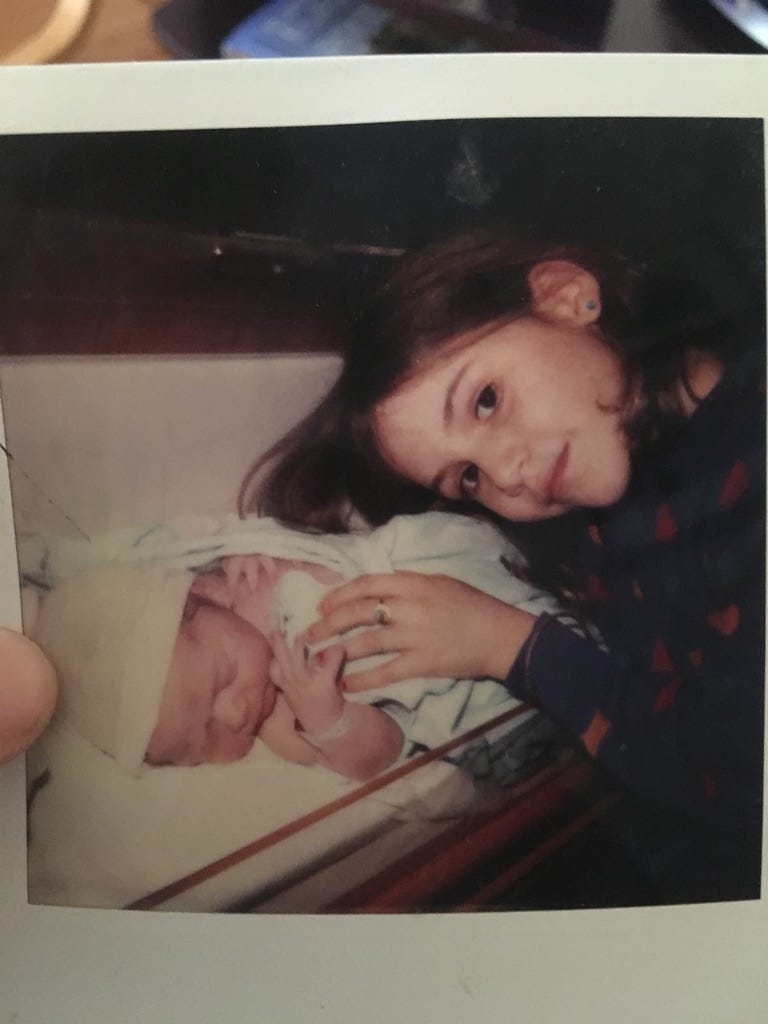
When my sister arrived, I promptly became the town crier, passing out pink cigars, writing pages and pages in my third grade journal. I was a tiny little adult dispatched with the outsized responsibility of telling the world of “my” news.
To be clear: No one assigned me this task. I just knew it was mine. She was as much my baby as she was my parents’ baby.
I was in the room when she entered the world. I learned her cries. I learned which one meant hungry and which one meant tired and which one meant nothing at all except that she wanted to be held. We shared a room for the first three weeks or so and I was often the one who got up with her in the night to hand her off to my mother.
I was a child myself, holding a child, and I felt, even then, the small swell of being needed. Of being the one who could handle shit.
I’ve been chasing that high ever since. And mostly did it alone.
It would be decades before anyone started talking about what it means to be an eldest daughter. To hold both the love and the overwhelming responsibility for a child not your own. To both resent and care for someone smaller than you while you were still watching the Smurfs, eating Fruit Loops and sleeping the light on.
“Be an example Sasha.”
I was managing the emotional load of our household, calming an infant, and pushing a baby in a baby carriage before I learned my multiplication tables.
Eldest daughter syndrome is a colloquial term that is very real to those of us who live inside of it. It’s a condition described as essentially being robbed of a childhood so that you could be responsible for the younger siblings in your family. For those of us living it, it also comes with a heaping side of perfectionism and the sense that you will only be loved if you win all the time and execute everything with flawless precision.
People expect much of girls regardless of birth order. They expect chores and help in the kitchen. They expect caregiving and laundry.
People also expect a lot of the oldest child.
After all, no matter how young the child, by virtue of being the oldest, you are automatically more mature.
Put those things together and you’ve got a perfect storm. In other words, there is no rest for an eldest daughter.
Eldest daughters are having a moment in pop culture right now. The invisible burden we once carried alone and without a name is now loud and set to music.
Taylor Swift is singing “Every eldest daughter was the first lamb to the slaughter.” Let me tell you of the collective sigh every girl who has ever wanted to check the “head of family” box at age 10 had when Swift released that album.
YES, Taylor. We see you. And you see us. Fist bump.
There’s a whole reel subculture on TikTok and Instagram dedicated to the younger generation X and older millennials who are looking around at their life and realizing that they’ve been 42 since they were 11.
I feel so seen.
But it’s always been there, hiding in plain sight.
It’s been in the books and the shows and the songs we all grew up with and loved. We just had to point our gaze in the right direction.
Look at the Kishi sisters in The Baby-Sitters Club, the series that defined so many late Gen X and early millenial childhoods about a group of 12-year-olds who formed a business around the care and feeding of younger children.
Claudia gets to be the artist. She is the cool one, the creative one, the one in the wild earrings who hides candy around her bedroom and cannot spell to save her life and does not especially care.
Her parents are hard on her sometimes, disappointed in her grades, worried about her future. But the weight does not sit on her. It sits on Janine.
Janine the genius. Janine the older sister taking college courses while she is still in high school, the one perpetually at the computer, perpetually studying, perpetually performing.
She is the one no one frets about, because she is handling it. She always handled it.
Even in 1987, even in a paperback you could buy at the Scholastic book fair, Janine was lonely.
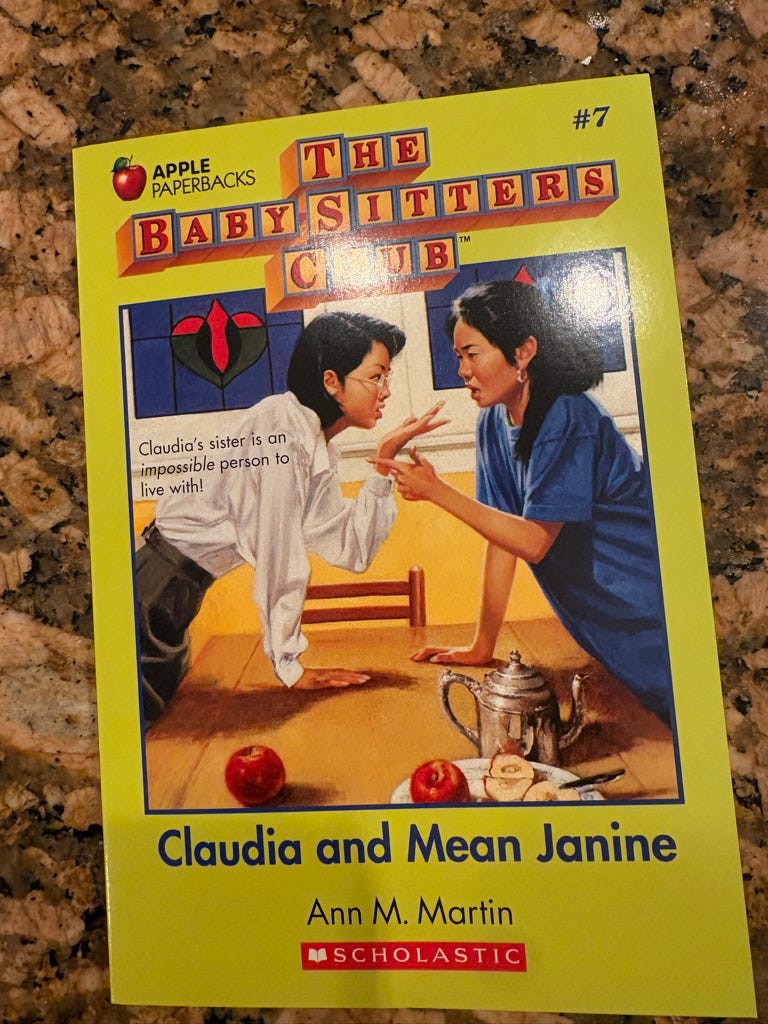
The whole emotional turn of Claudia and Mean Janine, the seventh book in the Baby-Sitters Club series, arrives when we learn that the stuffy, friendless older sister was jealous of the younger one.
Not of her grades.
Of her ease.
Claudia got to be social, got to be wanted, got to be a kid. All Janine ever wanted was to be included, to be part of the family rather than the family’s resident achiever, kept at a polite distance by her own excellence.
When Janine finally says that all anyone ever tells her is to study, that no one ever just asks her to come along, she is speaking for older sisters everywhere. It just took us a few years to catch on.
Janine would be fine, because she was always fine, because being fine was the only role available to her. No one is mean to Janine, exactly. They just never think to ask if she needs anything.
Ask any older sister if competence is a trap and we will nod our heads until our necks ache. Yes. Yes it is.
As I age, I’m learning that saying “I don’t know” is okay sometimes, too. That sometimes I’m the one who needs help and that asking for it isn’t the serial killer hiding in my closet.
It still fills me with dread to ask for a favor. I still say thing like “I’m so sorry but only if you want to no really I can do this myself forget it!” But I force myself to anyway. At least once every other year.
I kid. Kind of.
Because when you are always OK, you have to always be OK.
Even when you’re not OK.
In my case, being the big sister came on top of something even heavier: my mother died when I was 16. I then felt the weight of responsibility when it came to my younger sister.
Who would explain periods to her? Who would listen to her boy troubles and take her to get birth control?
She was 7.
After my mother died, a friend who had also lost her mother and also was a big sister wrote me a letter, walking me through the number of responsibilities I now held for the second grader I hadn’t birthed.
It felt massive. And overwhelming. I’ve tried to fill it. Even when I resented it.
I moved her out of apartments with my toddler on my hip. I’ve moved her in and out of dorm rooms. I’ve sent her Tampax care packages when she got her period at camp and I’ve rushed over when she’s had the inevitable boy troubles.
My husband and I have joked she’s our first baby for years.
My sister has my back, too. In ways that only a little sister can.
We are so close now that we talk roughly every hour, all day, every day. But for a long time what we had lived somewhere in the unmapped country between sibling and parent. I worried. I lectured. I fretted.
Now that she is a mother herself, the dynamic has shifted, gotten more fierce, more equal, more like two grown women standing shoulder to shoulder than one girl bent over another.
The ledger took a long while to balance.
Which brings me to Elizabeth Wakefield.
In Sweet Valley High, another series that defined the childhoods of Xennials about identical twins who dramatic and perfect lives with their perfect families in a perfect SoCal town called Sweet Valley. Elizabeth and Jessica are identical twins, born on the same day. Same dimples. Same size six figures (we get it). Even the same lavelier necklaces.
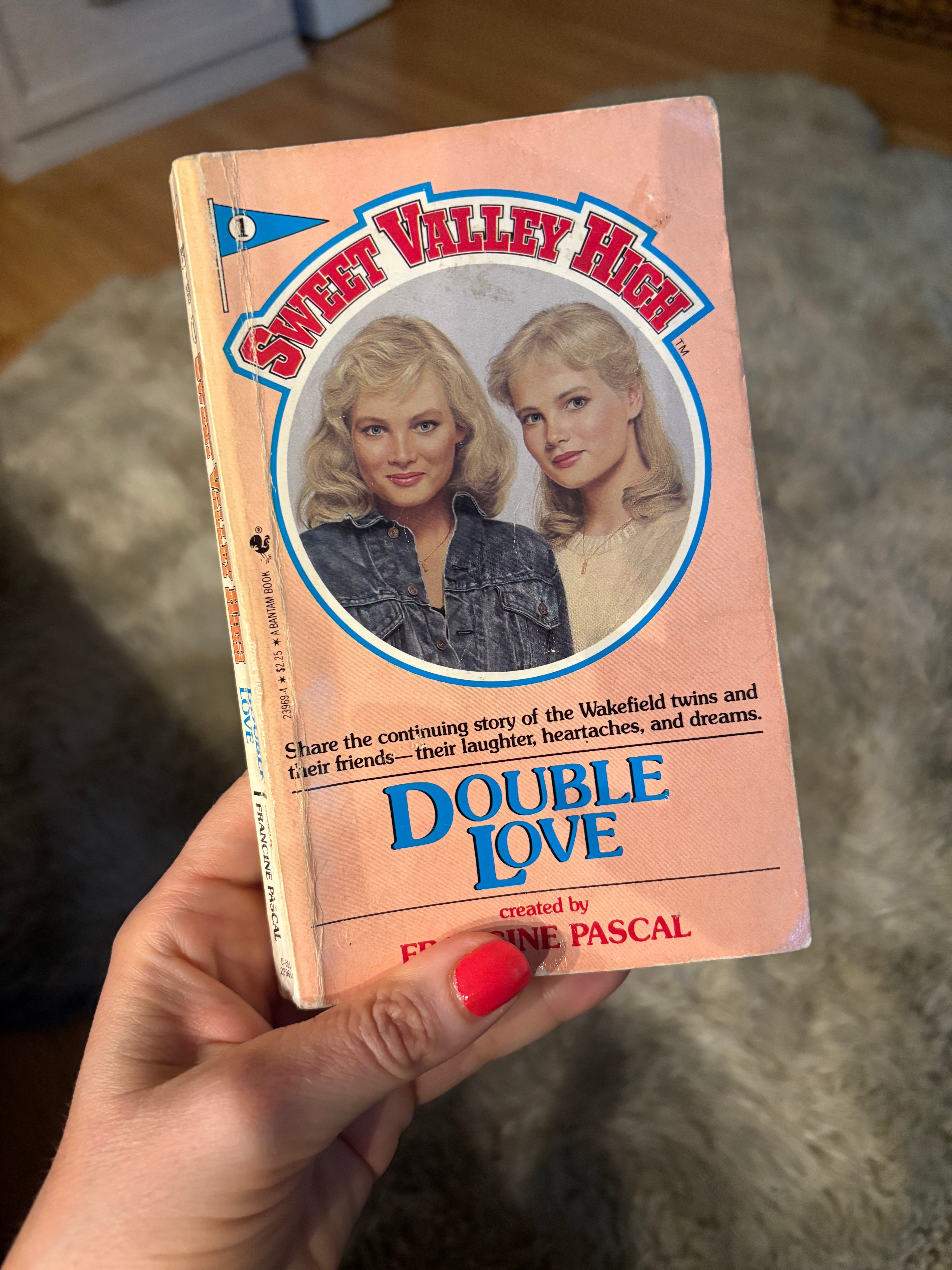
But Elizabeth is older by four minutes and those four minutes make her the responsible one, the steady one, and the one who always, compulsively cleaned up the messes her sister leaves behind.
Jessica gets to be impulsive and selfish and thrillingly fun. Jessica gets to be the baby.
Birth order is not really about the minutes. It’s about the load and who has to carry it.
The pattern runs straight through the classics. Meg March is the oldest of the four sisters in Little Women, the one who takes on adult worry before she’s grown. Meg is the responsible one. Meg is fine.
In The Hunger Games, Katniss steps forward to save her little sister. As if there was ever a question.
The research supports the books.
Eldest children, and eldest daughters in particular, tend to be high achievers. But the achievement arrives strapped to endless pressure. We eldest daughters are the family’s first experiment. The first pancake.
Oldest daughters are raised by parents who are themselves doing the whole thing for the first time. We absorb all their anxiety and hope.
We learn early that love and performance run side-by-side. We learn that approval is a thing you earn. That we are only useful when we are achieving and that no matter what we achieve, we always could have done better, rode harder, won more.
I am typing this essay at 8:12 PM on a Tuesday in a bathrobe home alone with my children because my husband is in Europe. I already worked a full day.
I haven’t had dinner yet.
I am the eldest daughter of an eldest daughter of an eldest daughter and an eldest son. I was the first granddaughter in my family. The first niece. This is the only way I know how to roll.
Work and work and work some more.
The road I walked was completely unpaved. Both my parents believed deeply in achievement. Both were highly educated and both were certain that the way to be loved in this world was to be excellent.
So I performed. I became a perfectionist. I developed an eating disorder.
While eating disorders and being an oldest daughter aren’t necessarily correlated, there is a connection between perfectionism and eating disorders.
And there ain’t no perfectionist worse than a girl who believes she’s walking a tightrope above her siblings.
When my mother died, I tried to be more for my sister than I might have been otherwise.
Now in my 40s, I’m an eldest daughter married to a youngest son. I’m so tired of making decisions.
Sofa King tired.
In the 2021 Disney film Encanto, oldest sister Luisa sings “Surface Pressure.” The song is a sort of anthem for us “strong ones.” Luisa sings of carrying the weight of every family burden on her back. Of becoming convinced that her purpose is to “be of service.” Of never being asked whether the weight is too much.
She sings “pressure that’ll just drip, drip, drip…” and every girl who has ever shouldered the weight of expectations at the expense of joy (read: 99 percent of the big sissy universe) is ready to give her a standing ovation.
Meanwhile Luisa’s family just handed her more.
Typical.
You’d think I, of all people, would know better.
But the joke’s been on me all along.
I have two daughters. An oldest and a youngest, with a middle son standing between them.
My oldest is home from college and her absence has made some things clear. The standards to which she holds herself are high. Impossibly high. The pressure she puts herself under is more than any human should bear.
“That’s just her,” my husband says.
But is it?
I’ve made a point this summer, while she’s home to remind her she’s still a kid. Even at 19. That she doesn’t have to carry it all. Last week, I hugged her tightly as she tried to wriggle away.
“You do not have to be perfect to be loved. You only have to be yourself.”
Why did this seem to come as a surprise to her?
When she looked at me, eyebrows raised, I realized I’d done it unconsciously. Without meaning to. That I’d looked at my daughter, just 18 months when her brother was born as a “big girl.” After all, compared to my pink toed newborn boy, she was.
I didn’t mean to do it. I should have known better. But I did it anyway.
She’s the leader of the pack. The 7-year-old I entrusted to hold her newborn sister while I showered. “Just 5 minutes,” I’d promised. She’d smiled proudly then. Another older sib bites the dust, finding joy in her ability to get shit done.
The responsible one. The one who takes it all on herself.
She assures me that the most important people in her life are her siblings. But that doesn’t let me off the hook.
Somewhere along the way, it did become easier to assign her the leader role. Sitting on the parent’s side of things, I see how it works. Your mind really doesn’t grasp that they are still little when there is someone so much littler clinging to your leg.
My oldest daughter is so capable. The “one we can trust.” But is that really her? Or is that just what we needed?
Good lord. Had I unwittingly turned my daughter into Janine Kishi?
“I’m going to tell you this more,” I told her. “Until it’s awkward.”
She rolled her eyes. But I’m not kidding. I’m going to keep repeating this until she hears me.
You aren’t in charge. You are a kid. You are enough exactly the way you are.
It’s all true.
All she’s ever had to be is her beautiful, full, and true self. I’d be proud of her for it all.
I’m not dumb enough to think a single conversation can undo the 17.9 years of training that followed the birth of her brother, but she’s only 19. And she chose a university a plane ride away, far away from familial obligations.
There is time and distance to undo a pattern none of us realized we were reliving.
It’s not too late for me, either. Even in my late 40’s.
I’m learning to say no more. To rest. I’m learning to prioritize the things I care about and skip a workout (the horror!) once in a while.
I still feel like hiding under the covers when I ask for help and someone hesitates.
(NOTE: Please understand that if an older sister asks you for a favor, she’s probably had to take 15 deep breaths and a Valium to do so).
I still sometimes find my mind racing when I’m reading a book on a Saturday afternoon and a list of chores starts scrolling through my head like the opening credits to a Star Wars movie.
But I’m getting better. One terrifying moment of vulnerability at a time.
Next month my precious 2-year-old niece will become an eldest daughter. This is a bond I’m excited to share with her.
I’ve got so many plans. I want to tell her that being a big sister is the best thing in the world. You get a best friend and a companion and your biggest cheerleader all rolled into one sweet package.
There is no love like the love of a little sib. No one cheerleads for me harder than my baby sister. No one has my back more. Ask many big sibs and they’ll agree: The day your younger sibling is born is the day you were granted a ride or die for life.
But even as my niece loves her brother and discovers the fine art of being two years older and a million years wiser, I hope she won’t also feel the need to take on the world. I hope she’ll remember that she’s just a kid, too. That she will find joy in quiet moments and let other people pick up the slack sometimes.
To all the oldest daughters of the world, including Janine, Elizabeth, Meg, Luisa, Tay-tay, and my own beloved and precious daughter, I say this:
You are enough exactly as you are. You are loved exactly as you are. There is no performance, no achievement, nothing that could change that fact.
Sit on the couch. Prop up your feet. Rip up the to-do list.
Dear big sisters of the world: Joy is for you, me, and us, too.
If you are an older sister and you feel seen in these words, please share so we can find each other. I have a vision of an older sister support group on my page. In the chat. In the notes and in these essays. Let’s find each other and remind each other that we are all enough. Just as we are.
This is Part Two of a three-part series on the Baby-Sitters Club, inside The Books That Raised Us. Next: Claudia Kishi and the death of the weird girl. Subscribe so it lands in your inbox. Part one is here.
The summer of 2026 is also the summer of Adult Book It. Stickers. Prizes. Six books. No pizza, sorry.
I'm never leaving this Substack.
I'm 17 months older than my little brother and I distinctly remember being at the lake when we were kids and it looking like it was going to rain and the only thing I cared about was making sure he got out of the water. And also realizing he could care less about me getting out of the water and, like, just knowing in my bones that this is mostly a one way relationship. At nine years old!
The elder sister life is wild!